
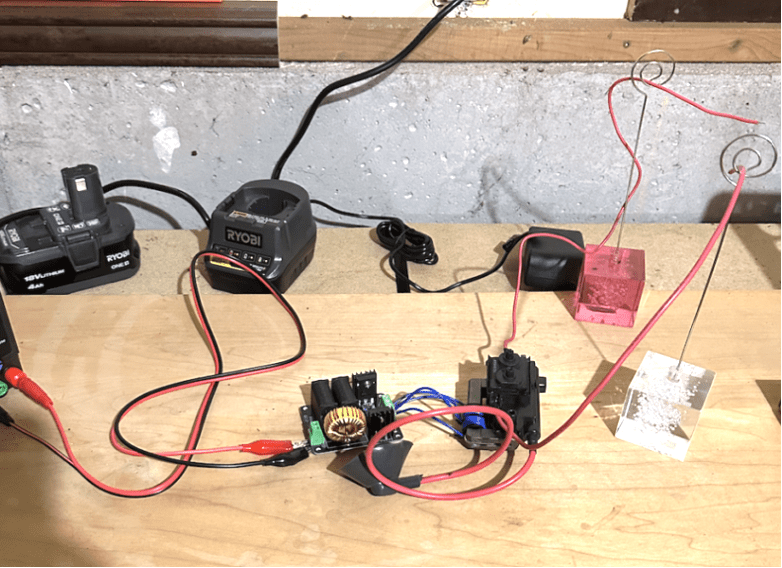
Hello, my name is Milton Hwang and I’m currently in grade 11. In my grade 10 year, I had the privilege of joining a cohort of 22 STEM enthusiasts to explore the wide field of technology and engineering: Fusion 10. In this program, we were assigned a final project to complete before the end of the year that involved making a finished product of any interest. As for me, I created an ozone hand sanitizer—a device that produces ozone, a bactericidal compound, through electric arcing. I will be explaining how I initially got this idea, the process involved in creating my first prototype, the final product, and the next steps to making it better and more accessible.
During my Fusion year in 2022-2023, COVID-19 still had a huge impact on many people’s lives, myself included. Wherever people went, they had to use hand sanitizers in almost every shop and restaurant. But I really hated those liquid hand sanitizers due to their unpredictable smell and often sticky characteristics, subsequently producing my definition statement: To create a machine that sanitizes hands quickly and effectively using ozone gas.
My initial idea was to create some sort of containment device for ozone and have holes for hands to go through. But then after some research, I found a video which was exactly what I needed, as well as answering a lot of the questions I had.
Before I get into the process of creating my design and prototype, I’ll first explain how ozone works. It is created when diatomic oxygen is exposed to an electrical field or ultraviolet light. Exposure to these high levels of energy causes a portion of the diatomic oxygen molecules to split into individual oxygen atoms. These free oxygen atoms combine with diatomic oxygen molecules to form ozone.
To put it simply, we need high voltage to create ozone.
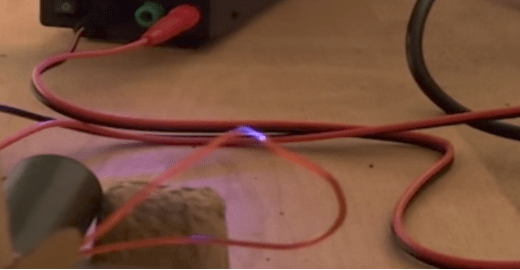
For this whole setup to work, there needs to be a significant difference in voltage between the object you wish to sanitize and the top plate—this is what causes the coronal discharge. But for the electrons to take the leap from the top plate to the object, the object needs to be charged, so it needs to be in electrical contact with the power source too. But instead of the metal conducting plate, I was thinking of using water as a conductor. So I planned to glue the acrylic sheets together with water in between with a copper wire sticking out to conduct electricity.
As I never fully completed my design, I think the next step would be to first make a presentable final product. Then looking onwards for electrical safety measures because it does involve high voltage hazards, material sustainability to ensure its product doesn’t decompose over time due to ozone, and making it compact and accessible for more people.
 Spotlight: STEM Publication